Oversized Cargo Transportation & Heavy Haul
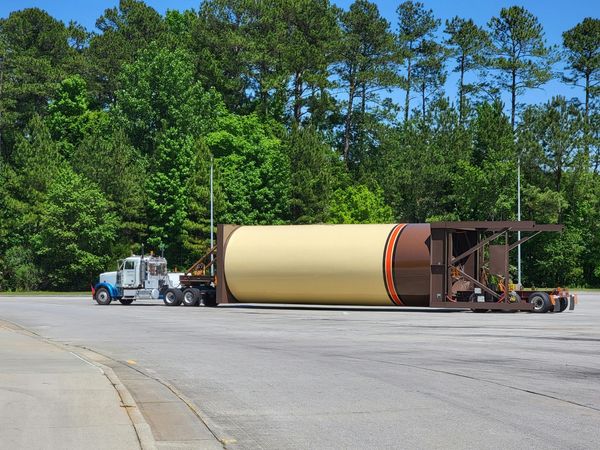
Oversized cargo transportation starts before the truck: the trailer has to fit the load, every state on the route has to issue a permit, and the escorts and travel times have to line up with your pickup and delivery sites. Cargo1 Logistics arranges oversized and heavy-haul freight across the United States — construction equipment, industrial machinery, transformers and generators, steel and prefabricated structures. We match the load to a specialized heavy-haul carrier and trailer, coordinate the permits, pilot cars and schedule with that carrier, and stay your one contact from quote to delivery. Every load moves with an FMCSA-authorized motor carrier whose authority and certificate of insurance we check before dispatch.
New to over-dimensional freight? The oversized freight guide — permits, routes and pro tips walks through it step by step. Ready to price a move? Request an oversized freight quote.
Oversized freight shipping: when a load needs a permit
A load needs a permit once the truck and freight together go over the legal size or weight limits. The federal limits below apply on the Interstate System and the National Network; each state sets its own rules on its other roads and issues oversize/overweight permits for its own highways.
| Limit | Legal without a permit | Notes |
|---|---|---|
| Width | 8’6” (102 in) | Federal width on the National Network |
| Height | 13’6” in most states, 14’ in some Western states | No federal height limit; each state sets its own |
| Length | 53’ trailer in most states | States must allow at least a 48’ semitrailer |
| Gross weight | 80,000 lbs | Interstate System |
| Single axle | 20,000 lbs | Interstate System |
| Tandem axle | 34,000 lbs | Interstate System |
A load can be oversize without being overweight, and the other way around: a compact machine can be legal in size and still overweight once the tractor and trailer are added. Permits are issued for loads that can’t reasonably be broken down — under federal rules, a load that would lose its use or value if split, or would take more than 8 work-hours to dismantle. If a boom, bucket or attachment can come off to bring the load under the limits, plan on it.
Oversize permits: who gets them
The carrier obtains the permits: the heavy-haul carrier we book applies for and holds the permit in every state on the route, because the permit is issued to the carrier for its truck, trailer and that load. Cargo1 coordinates the rest of the paperwork around it:
- We pass the carrier the exact dimensions, weights and pickup and delivery points, so the permits match the load.
- We agree the route and dates with the carrier and check each permit’s travel restrictions — daylight-only moves, weekend and holiday curfews, city restrictions — against your site hours.
- We line up pilot cars and any police escort the permits call for, together with the carrier, and price them into the quote.
Routine permits in most states issue within 1–3 business days; superloads take weeks. A multi-state move needs one permit per state, so the schedule follows the slowest and strictest state on the route.
When escorts and pilot cars are required
There is no single national rule: escort requirements vary by state, by type of road (two-lane or multi-lane) and by dimension. As a rule of thumb, a first pilot car is commonly required somewhere between 12 and 14 ft wide, front and rear escorts between 14 and 16 ft, and the widest loads can need police escorts. Tall loads get a front escort with a height pole, very long loads an escort of their own, and in Texas a load that needs escorts for two dimensions gets front and rear escorts. Two examples of how far the rules differ:
| Dimension | Florida | Texas |
|---|---|---|
| Width | Over 12 ft: one escort. Over 14 ft: front and rear escorts. Over 16 ft: local moves only, with two escorts on limited-access highways by day (a police escort plus one escort at night) and two police escorts on other state roads | Over 14 ft: one escort (in front on two-lane roads, behind on four or more lanes). Over 16 ft: front and rear escorts |
| Height | Over 14’6”: an escort with a height pole ahead of the load. Over 16 ft: a police escort as well, local moves only | Over 17 ft: a front escort with a height pole. Over 18 ft: front and rear escorts |
| Length | Over 95 ft: one escort. Over 150 ft: two escorts (one on limited-access highways) | Over 110 ft: one escort. Over 125 ft: front and rear escorts |
Rules change and every permit lists the escorts that load needs in that state, so treat the table as a guide to the cost and planning, not as the permit itself.
What is a superload?
A superload is a load so heavy or so large that it goes beyond what a routine oversize/overweight permit allows, so the state reviews it on its own. That usually means a bridge-by-bridge structural analysis, often a route survey, and sometimes utility crews to lift wires or police to hold traffic. Each state sets its own threshold — in Texas, for example, a load over 254,300 lbs gross, or over 200,000 lbs on less than 95 ft of axle spacing, is treated as superheavy and its bridges are checked one by one. Typical superloads are transformers, large generators, pressure vessels and heavy cranes moving on multi-axle or modular trailers. If your load might be one, talk to us weeks before the ready date, not days.
Trailers for oversized and heavy haul
- Flatbed — loads that are wide or long but not tall: steel, beams, lumber, crated machinery.
- Step deck (drop deck) — a lower rear deck for freight too tall for a flatbed.
- Double drop and RGN (removable gooseneck) lowboy — the lowest decks, for tall and heavy machinery; on an RGN the gooseneck comes off so equipment can drive on from the front.
- Stretch (extendable) trailers — for long steel, beams, poles and wind-turbine components.
- Multi-axle and modular trailers — spread superload weight over enough axles to meet bridge and axle limits.
The choice follows the dimensions, the weight, the center of gravity and the lifting points — send what you know and we propose the trailer.
Types of oversized cargo we ship
- Construction equipment — excavators, bulldozers, loaders, cranes
- Industrial machinery — presses, machine tools, production lines
- Prefabricated structures — modular buildings, steel frames
- Renewable energy components — wind turbine blades, nacelles
- Generators and transformers — high-weight utility freight
What we need for an oversized freight quote
- Dimensions — length, width and height of each piece, measured at the widest and highest points, including anything that sticks out (mirrors, booms, buckets).
- Weight — of each piece and in total, in pounds. For machinery the operating weight from the spec sheet is a good start.
- Pickup and delivery — full addresses, or at least the ZIP codes, plus anything about site access: gravel roads, low wires, tight turns, gates.
- Loading and unloading method — crane, forklift, drive-on ramps or riggers, and who provides them at each end.
- Dates — when the freight is ready, when it has to arrive, and the receiving hours at the delivery site.
- Photos or a drawing — and whether anything can be removed to make the load smaller.
Send it through the quote form (the dimensions go in the notes) or email it with photos to logistics@cargo1.us. We reply in writing within 2 business hours, Monday–Friday, 8:00 AM–5:00 PM MT; permits and route surveys take longer.
Tips for a smooth oversized move
- Plan early. Dimensions, weight and route decide how long the permits take — book routine oversize loads days ahead and superloads weeks ahead.
- Measure, don’t estimate. A permit covers the dimensions and weights written on it; a load that measures bigger at a scale or checkpoint is running outside its permit.
- Agree permits and escorts up front. The carrier obtains the permits for every state; we coordinate route, dates and escorts with it so you don’t chase them yourself. How permits, escorts and route surveys work, step by step: oversized freight guide — permits, routes and pro tips.
- Agree updates in advance. Check calls or GPS position updates at the frequency you ask for, and the driver’s phone number for the delivery site.
Explore more freight services
- FTL & LTL Freight Shipping
- Refrigerated Freight (Reefer)
- Expedited & Hotshot Delivery
- Hazmat & Dangerous Goods
- eCommerce & B2B Fulfillment
Sources: FHWA, federal size and weight limits; 23 CFR 658.5 (nondivisible load); Fla. Admin. Code R. 14-26.012; 43 Tex. Admin. Code § 219.11(k); TxDMV, superheavy single-trip permits; GAO-15-235SP, Texas permit profile.
Frequently asked questions
When is a load oversize or overweight in the US?
When it is wider than 8'6" (102 in), taller than the state's limit (13'6" in most states, 14' in some Western states), longer than the state allows (53' trailers in most states), or heavier than 80,000 lbs gross, 20,000 lbs on a single axle or 34,000 lbs on a tandem axle on the Interstate System. Beyond those limits the carrier needs a permit from every state on the route.
Who gets the oversize permits?
The carrier. The heavy-haul carrier we book applies for and holds the permit in each state on the route. We coordinate: we pass on the exact dimensions and weights, agree the route and dates with the carrier and check the permit's travel restrictions against your pickup and delivery times.
When does an oversize load need a pilot car?
It depends on the state, the road and the dimensions. A first escort is commonly required somewhere between 12 and 14 ft wide, front and rear escorts between 14 and 16 ft, and the widest or tallest loads can need police escorts. Florida, for example, requires one escort over 12 ft wide and two over 14 ft; Texas requires one escort over 14 ft and front and rear escorts over 16 ft. The permit for each state spells out what that load needs.
What is a superload?
A load beyond what a routine oversize/overweight permit allows, so the state reviews it on its own, usually with a bridge-by-bridge analysis and often a route survey. In Texas that means over 254,300 lbs gross, or over 200,000 lbs on less than 95 ft of axle spacing. Plan in weeks, not days.
Which trailers do you use?
Flatbed for wide or long freight that is not tall, step deck and double drop for taller freight, RGN (removable gooseneck) lowboys for heavy machinery that drives on, stretch trailers for long steel and beams, multi-axle and modular trailers for superloads. The choice follows the dimensions, weight, center of gravity and lifting points.
How long do permits take?
Routine oversize permits in most states issue within 1–3 business days; superload permits with route surveys and bridge analysis can take 2–4 weeks or longer. The carrier needs a permit from each state, so a Texas-to-Michigan load needs at least six permits, one per state.
Do you arrange escorts and police?
Yes, together with the carrier. Each state's permit says which escorts the load needs — pilot cars, a height-pole car, police where the state mandates — and they are priced into the quote.
Can you move oversized loads across several states?
Yes. Each state on the route issues its own permit with its own travel times — many allow oversize moves in daylight only and restrict weekends and holidays — so the schedule is built around the strictest state on the route.
What do you need for an oversized freight quote?
The dimensions and weight of each piece, pickup and delivery addresses, how it is loaded and unloaded, the ready date and delivery deadline, and photos if you have them. The full checklist is in the quote section above.
What determines the price?
Trailer type, loaded miles, permits and escorts per state, travel-time restrictions (nights, weekends, holidays) and the chance of a return load. Send the dimensions, weight and addresses and we quote the actual movement.
Get a quote
Origin and destination ZIP, pallets or weight, LTL or FTL, pickup date — a written rate from a person within 2 business hours, no obligation.
Request a quote